Teserax - Graph-Based Research Agent
Solo-built production TypeScript SaaS research agent that turns linear LLM chat into a graph-based exploration space with branching, synthesis, tool calling, RAG over live web sources, async orchestration, typed API contracts, and graceful failure recovery.
What this project proves
Solo-built graph-based research agent
Live TypeScript SaaS research agent with graph-based exploration, tool calling, live-source RAG, async orchestration, typed contracts, and graceful failure recovery.
Core challenge
Turn linear LLM chat into a non-linear research workflow that can branch, synthesize, and recover from long-running AI task failures.
Evaluation lens
Graph UX, tool-calling orchestration, live-source retrieval, typed APIs, and production deployment.
A live public SaaS product that combines research-agent behavior with a visual graph workflow.
 Live Product
 Overview
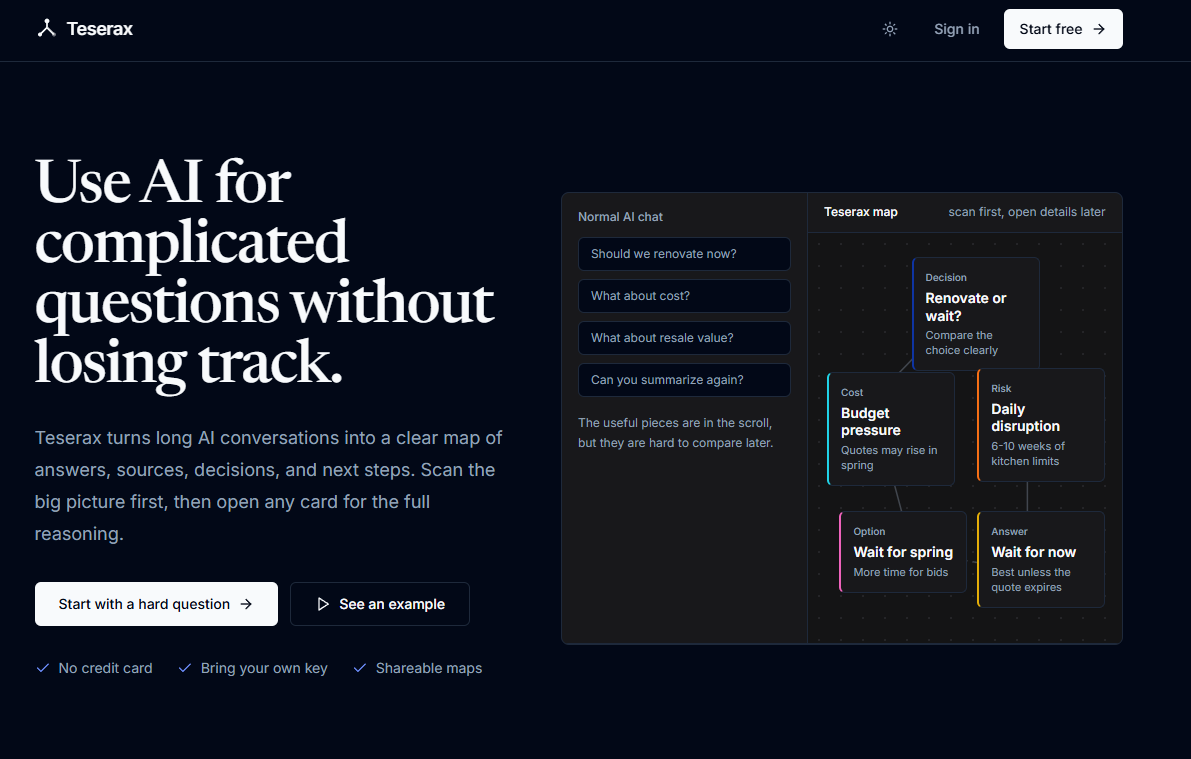
Teserax is a solo-built production SaaS research agent and graph-based thinking tool. The live product turns linear LLM chat into a visual, non-linear exploration space where users can branch into parallel lines of inquiry, merge or summarize findings, and synthesize insights on an interactive canvas.
Teserax began with a FastAPI backend deployed through EC2 and Cloudflare, then migrated to a TypeScript-native Hono/Node architecture. The current system serves the React/Vite frontend from Vercel, runs its persistent streaming backend on Railway, and uses Supabase for data and authentication. This evolution preserves the graph-based interaction model while giving long-running orchestration, shared Zod contracts, and persistence clearer production boundaries.
Product Walkthrough
Research on a graph
Teserax begins with a normal question, retrieves live sources, and preserves both the evidence and the generated answer as connected nodes. The chat panel remains available for follow-up questions while the canvas exposes how each result relates to the root question and the next suggested investigations.
Turn research into a tunable decision lab
The graph can expand beyond document-like answers into interactive artifacts. In this forecasting example, Teserax decomposes a World Cup prediction into expert analyses, calibration evidence, and a final synthesis, then adds controls that let the user adjust assumptions and rerun the forecast.
Compile instructions into executable workflows
Teserax can also turn natural-language goals into structured workflows. A workflow-control node defines the stages and variables, worker nodes execute focused research or analysis, and their outputs remain available as inspectable artifacts on the graph.
What I Owned
- Designed and shipped the product end to end as a solo project.
- Built the graph-based UX for branching, merging, summarizing, and cross-linking AI responses.
- Implemented multi-step agent orchestration with tool calling and retrieval over live web sources.
- Used Zod-typed API contracts to keep frontend/backend behavior explicit and testable.
- Added async workflow handling, retries, and graceful degradation for long-running AI tasks.
- Migrated the backend from FastAPI on EC2/Cloudflare to Hono/Node on Railway, with the React/Vite frontend on Vercel and data/auth on Supabase.
- Deployed and operated the live product at teserax.vercel.app.
Hard Problems Solved
- Research is non-linear: long-form analysis often branches and recombines. Teserax models that directly as a graph instead of forcing every interaction into a single chat transcript.
- Agent steps need structure: tool calling, RAG, retries, and async work require typed boundaries so failures are recoverable rather than confusing.
- Live-source context changes: retrieval over web sources needs graceful degradation when sources are unavailable, slow, or incomplete.
- Solo product ownership: the project required product design, frontend engineering, backend orchestration, deployment, and operational judgment in one system.
Key Features
- Graph-Based Exploration: Branch, merge, summarize, cross-link, and rewrite research paths on an interactive canvas.
- Agentic Research Flow: Multi-step orchestration with tool calling and RAG over live web sources.
- Typed API Contracts: Zod schemas keep request/response behavior explicit across the stack.
- Async Orchestration: Long-running research flows use retries and failure-recovery behavior for graceful degradation.
- Production Deployment: Vercel serves the frontend and forwards API traffic to a persistent Railway backend, with Supabase providing Postgres, authentication, and row-level security.
Why It Matters
Teserax is the clearest current proof of solo AI product engineering in the portfolio. It connects an interaction design idea, a graph-based product model, and agentic backend infrastructure into a live system that users can actually try.
Tech Stack
- Frontend: TypeScript, React, graph-based interaction UI
- Backend / AI: Hono on Node.js, tool calling, RAG, async agent orchestration
- Contracts: Zod typed schemas
- Data / Auth: Supabase Postgres, Auth, row-level security
- Infrastructure: Vercel frontend, Railway persistent backend